US financial policy is once again in the spotlight as Treasury Secretary Scott Bessent launched a stinging critique of the Federal Reserve’s conduct and messaging, specifically accusing the central bank of “fear mongering” over the inflationary risks of US tariffs. This renewed drama adds fuel to the ongoing friction between the Trump administration and Fed Chair Jerome Powell as the global financial community closely monitors the consequences for interest rates, the dollar, and global markets.
Bessent’s Criticism: Questioning the Fed’s MiUS financial policy is once again in the spotlight as Treasury Secretary Scott Bessent launched a stinging critique of the Federal Reserve’s conduct and messaging, specifically accusing the central bank of “fear mongering” over the inflationary risks of US tariffs. This renewed drama adds fuel to the ongoing friction between the Trump administration and Fed Chair Jerome Powell as the global financial community closely monitors the consequences for interest rates, the dollar, and global markets. Bessent’s Criticism: Questioning the Fed’s Mission and Effectiveness In a televised CNBC interview, Bessent bluntly challenged the Federal Reserve’s recent performance, suggesting the entire institution be re-examined. Drawing a provocative analogy, he argued, “If this were the FAA and we were having this many mistakes, we would go back and look at why this has happened.” Bessent questioned whether the Fed has truly fulfilled its mission, raising doubts about the track record of the central bank’s much-vaunted research staff — “All these PhDs over there — I don’t know what they do.” His comments come on the heels of continuous administration pressure for policy easing. President Trump has openly criticized the Fed for not cutting rates aggressively enough, and recent reports suggested he even mulled firing Powell. While Trump later denied immediate plans to dismiss the Fed Chair, speculation about the central bank’s future leadership only adds to market uncertainty. Tariffs, Inflation, and Political Drama The key source of contention: the Fed’s public warnings that Trump’s tariff policy could rekindle inflation. Powell himself recently noted that, absent tariffs, rate cuts might have already occurred in 2025, suggesting tariffs are a significant restraining factor. Bessent, in sharp contrast, contends that actual inflation data has been benign, with “great inflation numbers,” pointing out that price growth has remained manageable even as trade tensions elevate. However, economists and the latest data offer a more nuanced picture. Durable goods inflation rose 0.7% year-over-year in June, registering the second consecutive month of growth after over two years of declines, according to the latest Consumer Price Index (CPI). While the administration emphasizes overall price stability, targeted inflation in specific sectors remains a risk the Fed cites. Leadership Uncertainty Ahead Bessent’s remarks add another chapter to a year marked by unprecedented attacks from the executive branch on central bank independence. He further hinted at potential changes, noting, “Chair Powell’s term ends in May. There’s also another seat coming up in January. So we’ll see.” This looming leadership shuffle at the Fed injects fresh ambiguity into the macroeconomic outlook, with global investors pondering the implications for future rate policy, dollar strength, and asset volatility. Separately, frustrations over the Fed’s $2.5 billion building renovation have also spilled into public view, with Powell defending the outlay as necessary modernization. iXDeep: Market Impact Analysis At iXbroker, we recognize that political drama at the heart of US monetary leadership rarely leaves global financial markets unmoved. Here’s our iXDeep take on the unfolding confrontation: • Forex Markets: The renewed spotlight on Fed independence and potential leadership changes has emboldened volatility in the USD. Speculation over future rate decisions and the risk of executive interference widen trading ranges for major dollar pairs. If Powell’s successor appears politically motivated, market participants may attach a risk premium to USD assets, accelerating rotations into the euro, yen, or even gold. • Crypto Assets: Uncertainty about traditional monetary policy and the Fed’s long-term credibility often acts as a tailwind for crypto. Bitcoin and Ethereum, in particular, may see heightened appeal as investors seek hedges against both inflation risk and perceived policy mismanagement. If leadership instability fuels expectations of policy mistakes or unchecked inflation, the crypto complex could experience renewed inflows and price momentum. • Broader Markets: Both equities and treasuries are keenly alert to signals from Washington. Sudden shifts in the Fed’s tone or personnel could trigger sharp moves, especially in rate-sensitive sectors and high-duration assets. At iXbroker, we are closely tracking the interplay between political variables and market sentiment—helping our clients stay ahead in an era of institutional uncertainty.ssion and Effectiveness
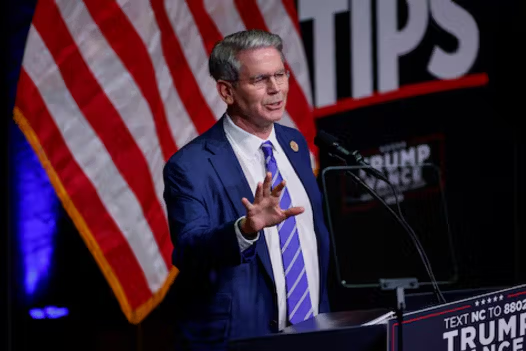
In a televised CNBC interview, Bessent bluntly challenged the Federal Reserve’s recent performance, suggesting the entire institution be re-examined. Drawing a provocative analogy, he argued, “If this were the FAA and we were having this many mistakes, we would go back and look at why this has happened.” Bessent questioned whether the Fed has truly fulfilled its mission, raising doubts about the track record of the central bank’s much-vaunted research staff — “All these PhDs over there — I don’t know what they do.”
His comments come on the heels of continuous administration pressure for policy easing. President Trump has openly criticized the Fed for not cutting rates aggressively enough, and recent reports suggested he even mulled firing Powell. While Trump later denied immediate plans to dismiss the Fed Chair, speculation about the central bank’s future leadership only adds to market uncertainty.
Tariffs, Inflation, and Political Drama
The key source of contention: the Fed’s public warnings that Trump’s tariff policy could rekindle inflation. Powell himself recently noted that, absent tariffs, rate cuts might have already occurred in 2025, suggesting tariffs are a significant restraining factor. Bessent, in sharp contrast, contends that actual inflation data has been benign, with “great inflation numbers,” pointing out that price growth has remained manageable even as trade tensions elevate.
However, economists and the latest data offer a more nuanced picture. Durable goods inflation rose 0.7% year-over-year in June, registering the second consecutive month of growth after over two years of declines, according to the latest Consumer Price Index (CPI). While the administration emphasizes overall price stability, targeted inflation in specific sectors remains a risk the Fed cites.
Leadership Uncertainty Ahead
Bessent’s remarks add another chapter to a year marked by unprecedented attacks from the executive branch on central bank independence. He further hinted at potential changes, noting, “Chair Powell’s term ends in May. There’s also another seat coming up in January. So we’ll see.” This looming leadership shuffle at the Fed injects fresh ambiguity into the macroeconomic outlook, with global investors pondering the implications for future rate policy, dollar strength, and asset volatility.
Separately, frustrations over the Fed’s $2.5 billion building renovation have also spilled into public view, with Powell defending the outlay as necessary modernization.
iXDeep: Market Impact Analysis
At iXbroker, we recognize that political drama at the heart of US monetary leadership rarely leaves global financial markets unmoved.
Here’s our iXDeep take on the unfolding confrontation:
Forex Markets: The renewed spotlight on Fed independence and potential leadership changes has emboldened volatility in the USD. Speculation over future rate decisions and the risk of executive interference widen trading ranges for major dollar pairs. If Powell’s successor appears politically motivated, market participants may attach a risk premium to USD assets, accelerating rotations into the euro, yen, or even gold.
Crypto Assets: Uncertainty about traditional monetary policy and the Fed’s long-term credibility often acts as a tailwind for crypto. Bitcoin and Ethereum, in particular, may see heightened appeal as investors seek hedges against both inflation risk and perceived policy mismanagement. If leadership instability fuels expectations of policy mistakes or unchecked inflation, the crypto complex could experience renewed inflows and price momentum.
Broader Markets: Both equities and treasuries are keenly alert to signals from Washington. Sudden shifts in the Fed’s tone or personnel could trigger sharp moves, especially in rate-sensitive sectors and high-duration assets.
At iXbroker, we are closely tracking the interplay between political variables and market sentiment—helping our clients stay ahead in an era of institutional uncertainty.