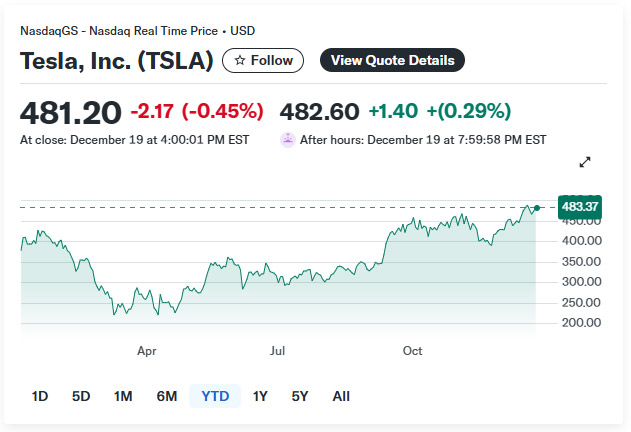
TSLA slipped by 0.45%, even as the broader S&P 500 (^GSPC) gained 0.88%, underscoring yet again that calm and predictability are rarely part of the Tesla investment story.
For Tesla shareholders, volatility is not the exception—it is the rule. The year 2025 proved to be another extreme chapter, marked by sharp swings, intense headlines, and a dramatic peak-to-trough trajectory. Still, despite the turbulence, Tesla shares reached a new all-time high this week, driven largely by renewed optimism around the company’s self-driving ambitions, and remain on track to outperform the S&P 500.
From political entanglements to unprecedented executive compensation and renewed confidence in robotaxis, three major developments defined Tesla’s eventful year.
Musk’s high-stakes political gamble with Trump
Elon Musk’s decision to publicly back President Donald Trump’s re-election campaign in mid-2024 quickly evolved into one of the most controversial chapters for Tesla in 2025. Musk reportedly spent more than $100 million supporting Trump, cementing a relationship that extended beyond shared ideology.
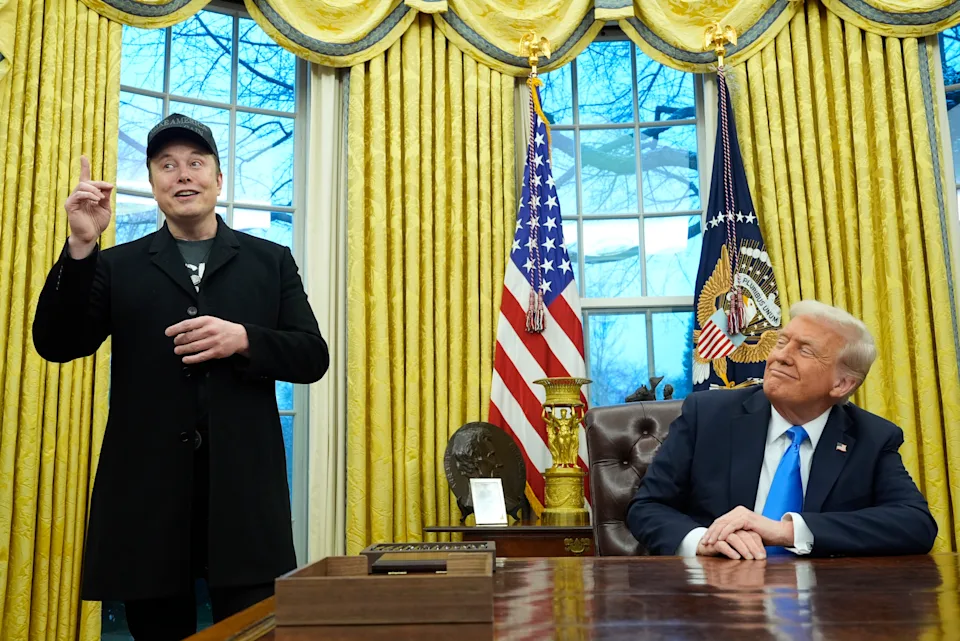
That alliance translated into privileged access to the White House and Mar-a-Lago, and culminated in Musk being appointed to lead the Department of Government Efficiency (DOGE), a newly formed initiative under the Trump administration.
The relationship, however, deteriorated rapidly.
Musk openly criticized Trump’s flagship “One Big Beautiful” spending bill, calling it bloated with pork-barrel spending. More critically for Tesla investors, the legislation eliminated federal EV and emissions tax credits—benefits worth billions of dollars to Tesla over recent years.
The public fallout between Musk and Trump rattled markets, dragging Tesla shares lower as investors grew increasingly uneasy about Musk’s deepening political exposure. SpaceX and other Musk-led ventures were also drawn into the crossfire.
“Very simply, Musk diving deeper into politics and now taking on the Beltway establishment is exactly the opposite direction Tesla shareholders want him to take,” Wedbush analyst Dan Ives wrote during the summer sell-off.
Trump, for his part, defended the bill and its rollback of EV incentives on Truth Social, while Musk escalated tensions by floating the idea of launching a third political party. A temporary truce was eventually reached after Trump re-nominated Musk’s preferred NASA administrator candidate, Jared Isaacman, calming tensions—for now.
For investors, the lingering concern remains whether Musk’s political re-engagement could resurface and once again pressure Tesla’s valuation.
A $1 trillion pay package that split Wall Street
In November, Tesla shareholders approved what may be the most extraordinary compensation package in corporate history: a performance-based plan that could ultimately deliver up to $1 trillion in total compensation to Musk.
The proposal passed with more than 75% shareholder approval, despite vocal opposition from major institutional investors, including Norway’s sovereign wealth fund and California’s CALPERS.
“I’d like to give a heartfelt thanks to everyone who supported the shareholder votes,” Musk said at Tesla’s annual meeting, adding that the company was “starting a whole new book.”
Tesla’s relocation to Texas played a pivotal role, as it enabled Musk to vote a larger portion of his own shares, effectively sealing approval.
The package is tied to extremely aggressive operational and financial milestones. These include delivering Tesla’s 20 millionth vehicle, deploying one million robotaxis, selling one million Optimus humanoid robots, and scaling EBITDA to $400 billion—up from $16.6 billion last year. To unlock the full award, Tesla’s market capitalization would also need to reach $8.5 trillion, compared with roughly $1.5 trillion today.
Proxy advisory firm Glass Lewis criticized the structure, warning that the board retains broad discretion to approve portions of the payout even if Musk falls short of stated targets.
While supporters argue the package aligns Musk’s incentives with long-term growth, critics see it as another governance red flag for the company.
Robotaxis move from vision to reality
If there is one narrative that has consistently buoyed Tesla’s long-term bulls, it is autonomous driving—and 2025 marked a meaningful step toward that vision.
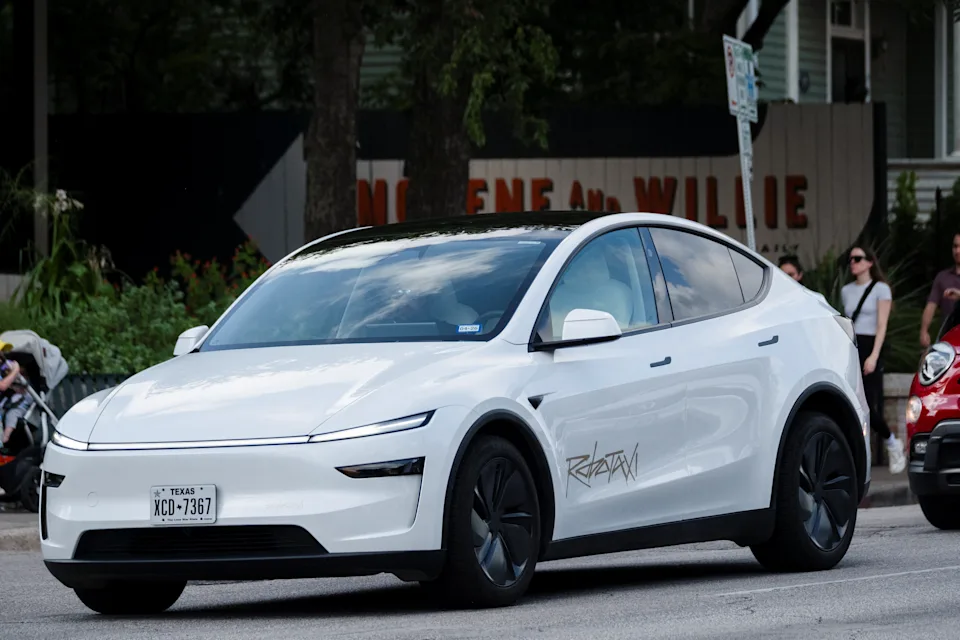
Tesla launched a pilot robotaxi program in Austin, Texas, using Model Y vehicles equipped with the latest version of Full Self-Driving (FSD) software, summoned via a dedicated Robotaxi app. While early operations included safety drivers and experienced minor disruptions, the program expanded steadily.
In December, Musk confirmed that Tesla had begun testing robotaxis in Austin without a safety driver, and similar testing is now underway in the San Francisco Bay Area.
Wall Street has taken notice.
“Heading into 2026, this marks a monster year ahead for Tesla as the autonomous and robotics chapter begins,” Wedbush’s Ives wrote, forecasting an accelerated U.S. robotaxi rollout and volume production of Cybercabs by late spring.
Morgan Stanley analysts have gone further, calling 2026 an “inflection point” for autonomous technology. “Full Self Driving is the crown jewel of Tesla’s auto business,” analyst Andrew Percoco noted, describing it as a durable competitive advantage.
Musk has doubled down on his timeline, stating that Tesla’s Austin robotaxi fleet could become fully autonomous within weeks. “I think it’s pretty much a solved problem; we’re just going through validation right now,” he said at a recent xAI event.
For Tesla shareholders, the promise of robotaxis represents more than technological progress—it is central to the company’s evolving AI-driven valuation.
As Ives summarized: “The march toward an AI-driven valuation for TSLA over the next six to nine months has now begun, with FSD adoption and robotaxi acceleration representing the golden goose for Musk & Co.”
Ready to start trading Forex? Join iXBroker today and kick-start your trading journey now!