
The Japanese Yen (JPY) recovers from early Asian session losses on Thursday, snapping a two-day decline against a broadly weaker US Dollar. The rebound is supported by rising confidence that the Bank of Japan will stay on its gradual policy normalization path, alongside lingering concerns over potential currency intervention.
At the same time, dovish expectations surrounding the Federal Reserve continue to weigh on the Greenback, capping the USD/JPY pair’s intraday advance near the 157.00 level.
That said, gains in the Yen remain restrained after data showed Japan’s real wages contracted at the fastest pace since January, reinforcing uncertainty over the precise timing of the BoJ’s next rate hike. With traders hesitant to commit to fresh USD bearish positions, market attention is shifting firmly toward Friday’s US Nonfarm Payrolls report, a key event risk for USD/JPY direction.
Safe-haven flows support Yen despite weak wage data
Government data released on Thursday showed that Japan’s average nominal wages rose just 0.5% year-on-year in November, the slowest increase since December 2021. More importantly, inflation-adjusted real wages declined for an eleventh consecutive month, falling 2.8% during the period.
The figures highlight the ongoing challenge facing the Bank of Japan, as inflation continues to outpace wage growth. While this dynamic complicates the policy outlook, BoJ officials have maintained that further rate hikes remain on the table if economic and price developments evolve in line with forecasts. BoJ Governor Kazuo Ueda reiterated this week that wages and prices are expected to rise in tandem over time.
Despite the weak wage backdrop, markets remain increasingly convinced that the BoJ will tighten policy further. This contrasts sharply with expectations that the Federal Reserve will begin cutting rates as early as March and potentially deliver another reduction later this year, a divergence that continues to favor the lower-yielding Japanese Yen.
Mixed US data keeps pressure on the dollar
Wednesday’s US macroeconomic releases failed to challenge dovish Fed expectations, limiting the US Dollar’s ability to extend its recent recovery. The ISM Non-Manufacturing PMI rose to 54.4 in December from 52.6 previously, signaling resilience in the services sector. However, the positive surprise was offset by softer labor market indicators.
ADP data showed US private-sector employment increased by 41,000 in December, following a revised decline of 29,000 in November and undershooting market expectations. Meanwhile, the JOLTS report revealed that job openings fell to 7.146 million in November, down from 7.449 million in October and below forecasts, pointing to easing labor demand.
With signals from the data remaining mixed, traders are opting to stay sidelined ahead of Friday’s Nonfarm Payrolls report, which is expected to provide clearer guidance on the Fed’s policy outlook and drive the next meaningful move in USD/JPY.
Technical outlook: USD/JPY holds key support zone
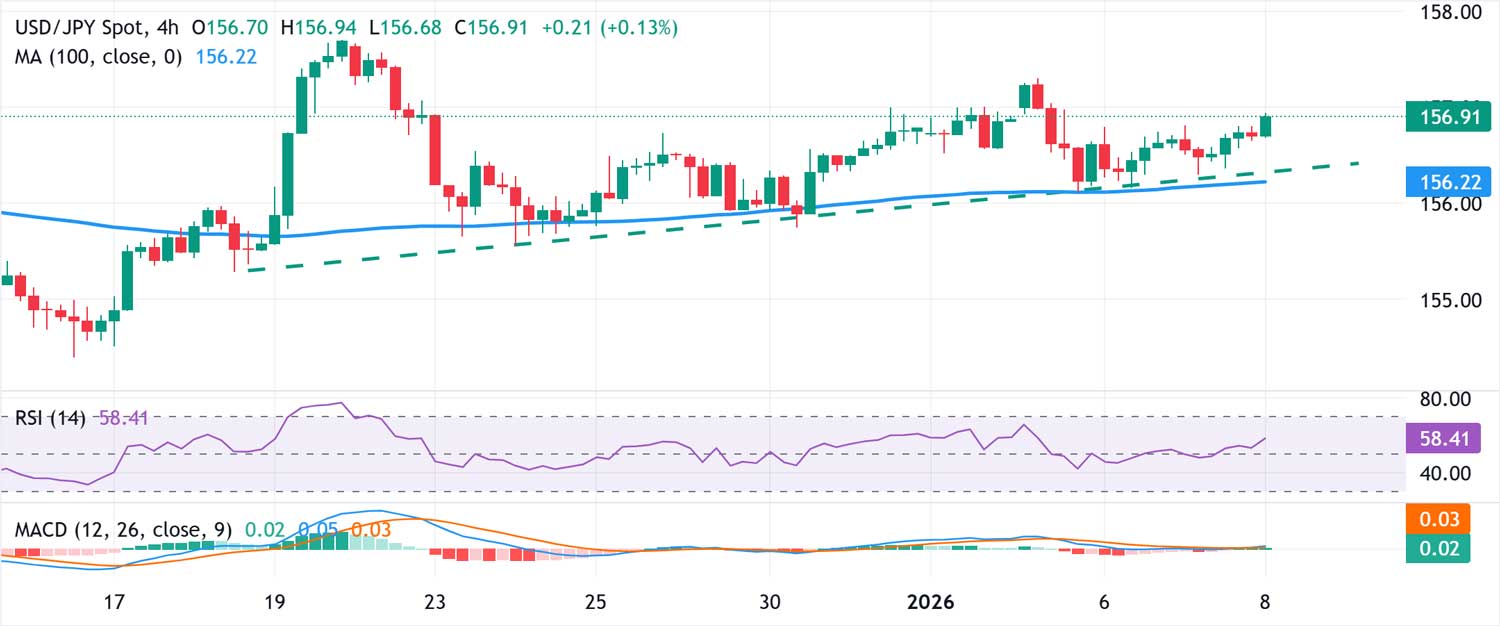
From a technical perspective, USD/JPY continues to trade above a key confluence support area between 156.35 and 156.25. The 100-period Simple Moving Average on the four-hour chart, currently near 156.22, is sloping higher and providing dynamic support, maintaining a constructive bias.
Momentum indicators also lean mildly bullish, with the MACD line crossing above the signal line near the zero level and a slightly positive histogram signaling improving momentum. The Relative Strength Index stands around 58, comfortably above the neutral 50 mark.
A rising trend line from the 155.30 area further underpins the pair, with support aligning near 156.36. Sustained trading above this zone would keep the upside bias intact, while a decisive break below the trend line could trigger consolidation and slow bullish momentum.
Ready to start trading Forex? Join iXBroker today and kick-start your trading journey now!