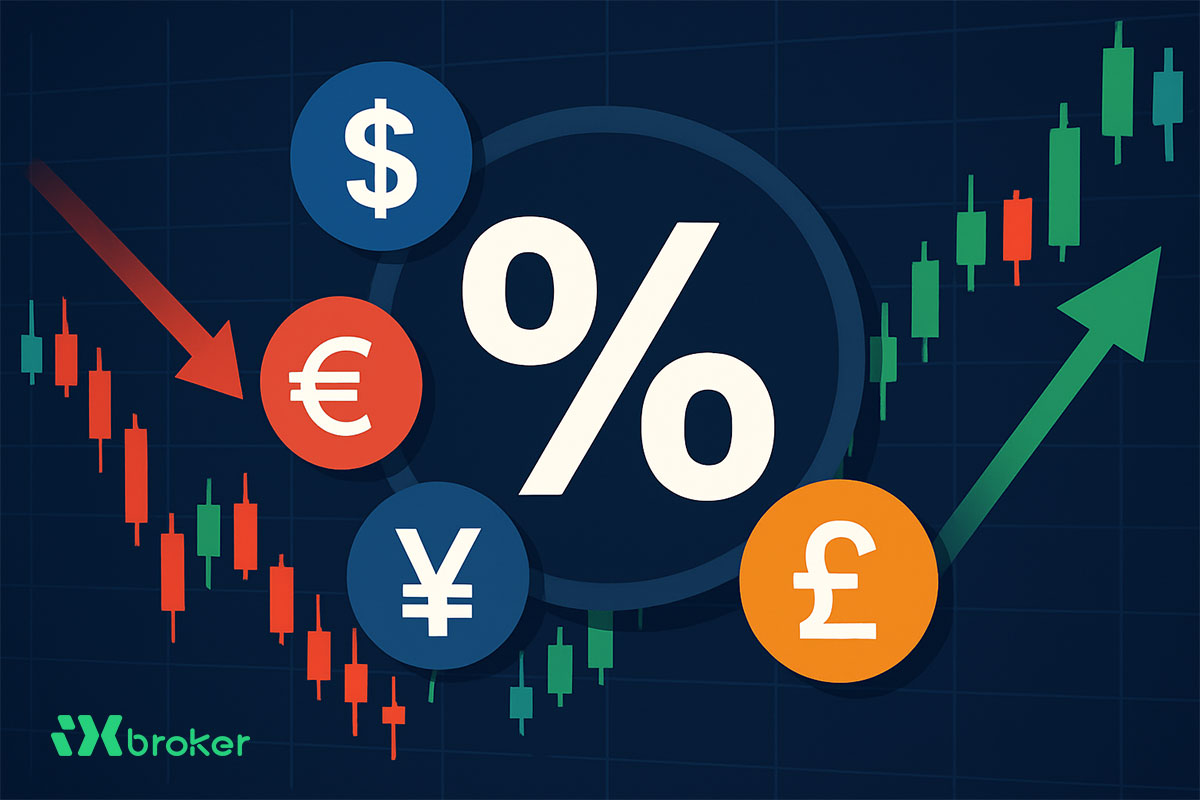
Interest rates remain the primary driver of currency markets, overshadowing all other factors. At the heart of Forex dynamics are the policy choices of central banks, whose decisions directly shape capital flows and currency valuations.
Why Interest Rates Dictate Forex Moves
The logic is straightforward: higher interest rates attract foreign capital by offering superior returns on bonds and deposits denominated in that currency. Conversely, lower rates reduce a currency’s appeal, pushing investors toward alternatives.
This relationship explains much of the US Dollar’s surge in 2022–2023, when Federal Reserve (Fed) rate hikes propelled the Dollar Index (DXY) to a twenty-year high. Today, however, the cycle has turned. Inflation is cooling, growth is softening, and the once-resilient US labor market shows signs of strain—prompting a reassessment of Fed policy.
Powell at Jackson Hole: A Shift Toward Easing
At last weekend’s Jackson Hole symposium, Fed Chair Jerome Powell signaled that monetary policy remains “restrictive,” while risks are now tilting toward the labor market. Importantly, he left the door open to a first rate cut as early as the September 17 meeting.
Markets reacted swiftly. Bond yields fell, and the US Dollar retreated against both the Euro (EUR) and Japanese Yen (JPY). According to the CME FedWatch Tool, markets now assign an 84% probability to a 25-basis-point cut in September, with traders pricing in two more cuts before year-end.
Forex Impact: Dollar Under Pressure
Lower US rates reduce the yield differential with peers such as the ECB and BoE. If the Fed cuts faster than Europe or the UK, the Greenback will lose its relative appeal, paving the way for EUR/USD gains—as reflected in the pair’s rebound above 1.15 in recent weeks.
Still, uncertainty lingers. A resurgence in inflation—possibly driven by Trump administration tariffs—could slow the pace of easing, lending fresh support to the Dollar. Conversely, a sharper downturn in the labor market might compel Powell to accelerate cuts, further weakening the USD.
The Role of Expectations
In Forex, expectations matter as much as actual decisions. Traders often move ahead of central banks: a “dovish” Powell speech can sink the Dollar even if rates remain unchanged, while a “hawkish” tone can strengthen it despite a status quo outcome.
A Strategic Turning Point
For market participants, this autumn may represent a decisive turning point. A weaker Dollar could benefit emerging-market currencies and high-yielders such as the Canadian Dollar (CAD) and Australian Dollar (AUD).
Ultimately, interest rates remain Forex’s number-one barometer. As Powell prepares markets for policy easing, traders face a new landscape where every Fed signal is a potential catalyst. For investors, monitoring central bank communication is not optional—it is essential.