iXbroker News | July 2025
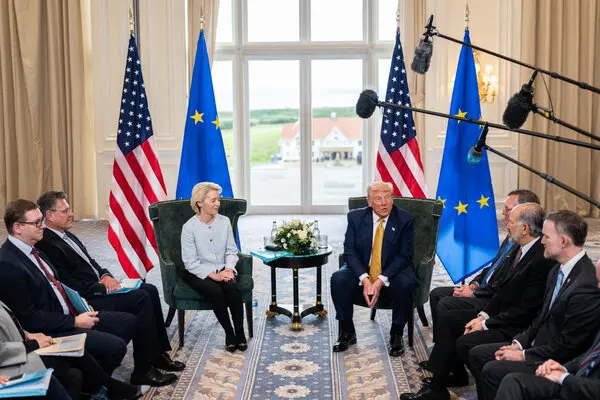
Global trade is once again at a pivotal crossroads, with Washington and Brussels sprinting to complete a sweeping transatlantic trade deal before the Friday deadline. President Trump and European Commission President Ursula von der Leyen jointly announced the framework for a new US-EU agreement, which will see a 15% baseline tariff rate on EU exports to the US—a move Trump called “the biggest of them all.” Market participants and industry giants are scrambling to assess the impact as talks with Beijing continue, with a 90-day extension of the US-China trade truce also widely expected.
The Last-Minute Rush: Transatlantic Trade in Focus
On the surface, the deal between the US and EU signals progress against months of escalating protectionism and uncertainty. Yet critics, including German Chancellor Friedrich Merz—who labelled the agreement “unsatisfying”—and France’s François Bayrou—who lamented a “dark day” for European independence—argue that the negotiated outcome represents more of a rushed patchwork than a strategic breakthrough.
The details are still evolving. For now, the agreement establishes a 15% tariff standard on EU goods imported by the US. Von der Leyen acknowledged the high rate, noting, “15% is not to be underestimated, but it is the best we could get.” Trump, currently meeting UK Prime Minister Keir Starmer in Scotland, suggested that a similar rate could soon be the global norm, stating, “For the world, I would say it’ll be somewhere in the 15% to 20% range.”
US Trade Representative Jamison Greer added that “more negotiations” are ahead with India, and Trump has also hinted at possible 35% levies on goods from Canada not covered by existing agreements. Simultaneously, the Trump administration celebrated a new deal with Japan featuring $550 billion in investments and—again—a 15% tariff baseline.
China: Truce in the Balance
While US-EU negotiations grab the headlines, global markets are also watching US-China relations. Talks with Beijing continue this week, with a 90-day extension of the existing trade truce now seen as highly probable. Hong Kong’s South China Morning Post and Commerce Secretary Howard Lutnick have both signaled that a renewed pause in the trade war is imminent—offering at least a temporary respite to global supply chains and equities.
Yet, the continued ambiguity around long-term agreements—and active threats of higher levies for some nations—means risk remains a feature, not a bug, in the current outlook.
Corporate Giants Feel the Squeeze
Major global brands are already reporting the cost of Washington’s tough tariff stance. Procter & Gamble, the world’s leading consumer goods company, forecasted a $1 billion hit to profits in its new fiscal year, directly attributed to tariffs. The company responded with price hikes and cautious earnings guidance: while Q4 earnings surpassed analyst expectations, a leadership shakeup saw COO Shailesh Jejurikar announced as successor to current CEO Jon Moeller, effective January 2026.
Stanley Black & Decker, the renowned manufacturer, is bracing for an $800 million impact in 2025, underscoring how higher tariffs are bleeding into margins and consumers’ wallets.
As Siebert Financial CIO Mark Malek explains, however, “progress in various trade talks suggests that worst-case scenarios are being avoided—so I think for the most part we’re happy.” Markets, for now, appear to be breathing a sigh of relief; Tobin Marcus of Wolfe Research described the outcome as “better-than-feared,” especially noting the comfort markets take in seeing a sector-wide rate set at 15%, rather than the possible extremes previously threatened.
What’s Next? (Legal Hurdles and Market Sentiment)
Despite headline progress, the fine print of the US-EU agreement still requires wrangling. A joint statement is expected before August 1, after which the US will begin reducing tariffs on specific sectors—most notably, cars and car parts (currently taxed at 27.5%). The implementation of any final, legally binding deal could stretch on for months or even years, with approval needed from the EU’s member states and, likely, the European Parliament.
For now, both sides hope that incremental progress will ease tensions and inject some confidence into battered supply chains.
iXDeep: Market Impact Analysis (Forex & Crypto)
Forex Implications
- US Dollar Demand: A partial resolution to trade uncertainty modestly boosts risk sentiment, reducing demand for the USD as a safe haven—especially if looming worst-case trade wars are avoided.
- Euro Volatility: The euro may remain under pressure, given EU leaders’ concerns about unfavorable tariff terms and potential negative effects on Germany and France, key economic engines for Europe.
- Commodity Currencies: Currencies linked to exports and global trade flows (like CAD, AUD, and JPY) may remain volatile, especially as further details emerge about future tariffs on Canada and ongoing negotiations with Japan and India.
Crypto Markets
- Risk Appetite: When worst-case trade scenarios are averted, speculative assets like Bitcoin, Ethereum, and altcoins often see inflows as risk appetite returns.
- Hedging Behavior: Persistent uncertainty (especially if trade talks stall or new tariffs are imposed) can see renewed “digital gold” narratives boost crypto—both as a hedge and a liquidity tool.
- Sectoral Rotation: With companies like P&G and Stanley Black & Decker warning of lower profits (and raising prices), consumer inflation pressures may indirectly impact crypto sentiment, as investors seek assets with inflation-hedge narratives.
Bottom Line:
The current trade landscape is far from clear, but for now, incremental deals and truce extensions appear to be keeping financial markets—and crypto traders—cautiously optimistic. iXbroker will continue to monitor every twist and turn.