U.S. equities retreated modestly on Wednesday, the final full trading session of 2025, though the pullback has done little to overshadow what has been a robust year for risk assets. The S&P 500 slipped around 0.2%, matching losses in the Nasdaq Composite, while the Dow Jones Industrial Average underperformed with a decline of roughly 0.5%.
Despite a mild three-session losing streak, major indexes remain firmly on track for strong annual gains. The S&P 500 is poised to finish 2025 up approximately 17%, marking its third consecutive year of double-digit returns. The Nasdaq has outperformed with a gain of about 21%, driven largely by continued enthusiasm around artificial intelligence, while the Dow has lagged with a still-solid 13% advance due to its lower weighting in technology stocks.
December strength largely intact despite late softness
From a seasonal perspective, December has once again delivered for equity investors. Both the Dow and the S&P 500 are on pace to close the month higher, potentially recording an eighth straight monthly gain, a streak not seen since 2018. The Nasdaq, by contrast, has traded roughly flat in December, highlighting a more selective market environment as the year draws to a close.
This divergence suggests that while broader momentum remains positive, leadership has narrowed, particularly within growth and technology-oriented segments.
Corporate and economic signals remain supportive
Corporate developments and economic data provided a mixed but generally stable backdrop. Shares of Nike (NKE) rose after multiple insiders, including board members and the chief executive officer, increased their holdings following a challenging year in which the stock declined more than 17%.
On the macroeconomic front, U.S. labor market data continued to point to resilience. Initial jobless claims fell to 199,000 in the latest reading, well below expectations, while continuing claims also declined. The data reinforce the view of a low-hire, low-fire labor environment as 2025 comes to an end.
Markets rebound from early-year turmoil
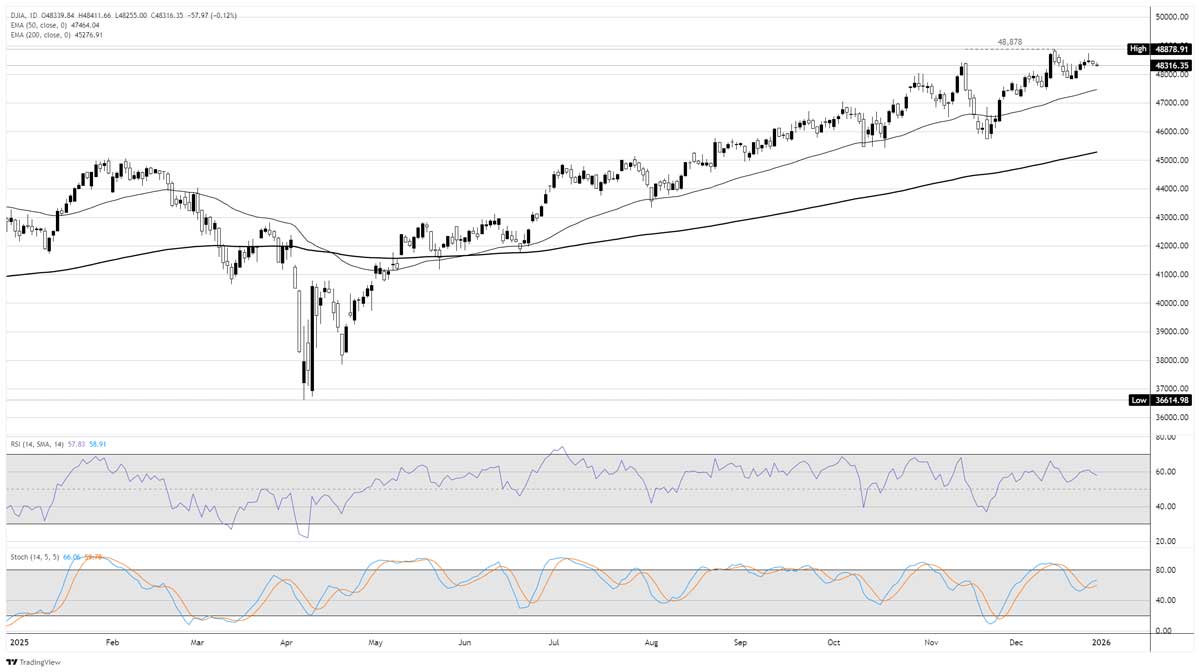
The year-end strength represents a sharp turnaround from the volatility seen in early April, when sweeping tariff announcements triggered a near bear-market drawdown. At that point, the S&P 500 was down nearly 19% from its February peak. Since then, investor confidence has improved as markets concluded that trade policy risks were better understood and that companies could adjust supply chains and pricing strategies to protect margins.
Still, the recent bout of profit taking has raised some caution. The final days of December and the opening sessions of January are typically associated with the so-called Santa Claus rally, and the absence of a strong year-end surge may point to choppier conditions ahead.
Shifting leadership and broader market drivers
While many strategists continue to expect positive equity returns in 2026, debate is growing over whether gains will become more range-bound as earnings growth works to justify elevated valuations. Artificial intelligence remains a powerful theme, but its influence has become more nuanced compared with prior years.
After outsized AI-driven rallies in 2023 and 2024, leadership broadened in 2025 and performance among megacap technology stocks diverged. Alphabet emerged as a standout with gains exceeding 65%, while Amazon posted a far more modest advance. At the same time, performance outside the technology sector improved notably, with commodities delivering exceptional returns. Gold rose more than 64% in 2025, while silver surged over 140%, marking their strongest annual gains since the late 1970s.
This shift in market dynamics has reinforced expectations that future returns may depend more heavily on traditional fundamentals rather than accommodative monetary policy or massive AI infrastructure spending alone.
Ready to start trading Forex? Join iXBroker today and kick-start your trading journey now!