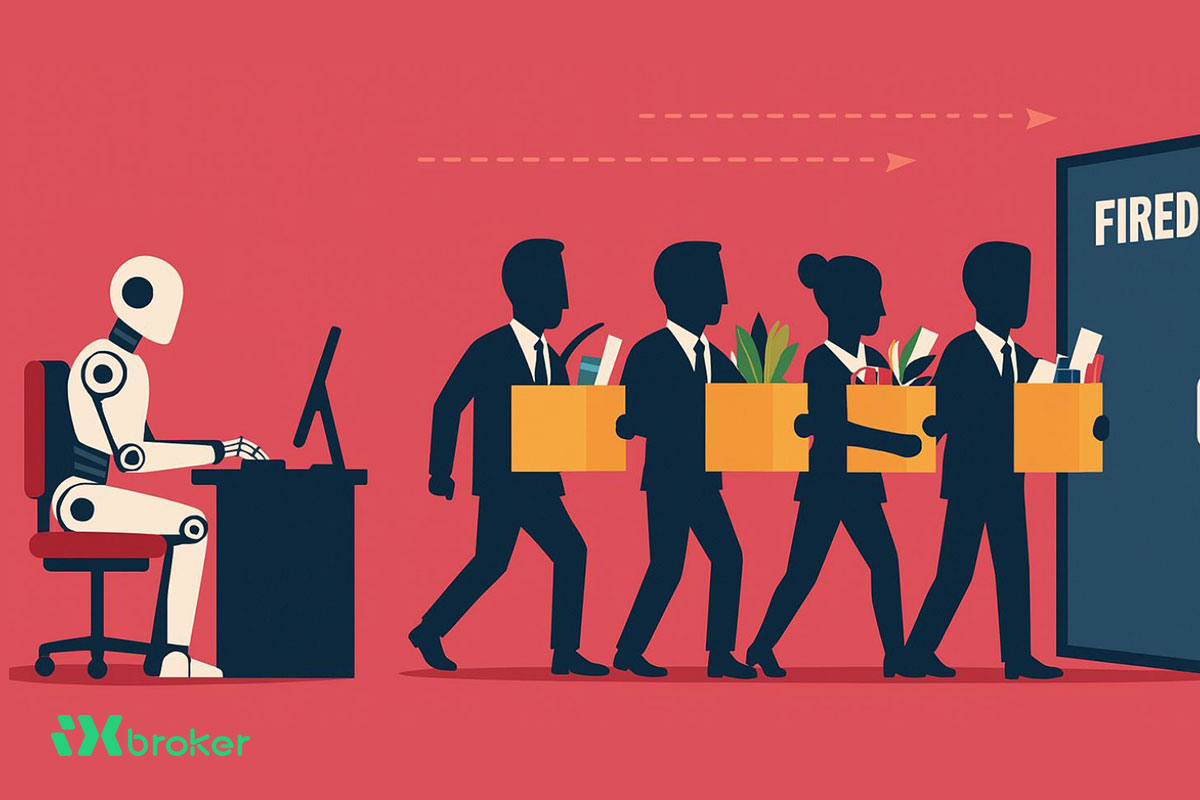
From tech to airlines, large global companies have been slashing staff as the real-world impact of artificial intelligence plays out, spooking employees. But critics say AI has become an easy excuse for firms looking to downsize.
Last month, tech consultancy firm Accenture announced a restructuring plan that includes quick exits for workers who aren’t able to reskill on AI. Days later, Lufthansa said it would eliminate 4,000 jobs by 2030 as it leans on AI to increase efficiency.
Salesforce also laid off 4,000 customer support roles in September, saying that AI can do 50% of the work at the company. Meanwhile, fintech firm Klarna has reduced staff by 40% as it aggressively adopts AI tools.
Language-learning platform Duolingo has also stated it will gradually stop relying on contractors and instead use AI to fill the gaps.
Critics say AI is a convenient scapegoat
Despite these announcements, some experts argue that AI is being used as a convenient scapegoat. Fabian Stephany, assistant professor of AI and work at the Oxford Internet Institute, told CNBC that many of the layoffs being attributed to AI are more about business strategy than automation.
“I’m really skeptical whether the layoffs that we see currently are really due to true efficiency gains. It’s rather really a projection into AI in the sense of ‘We can use AI to make good excuses,’” Stephany said.
He added that some firms may be positioning themselves at the frontier of AI innovation to appear modern and competitive, while concealing deeper operational or financial challenges. “There might be various other reasons why companies are having to get rid of part of their workforce … Duolingo or Klarna are really prime candidates for this because there has been overhiring during Corona,” he said.
Stephany argued that some companies that flourished during the pandemic “significantly overhired,” and the recent cuts are a kind of “market clearance.” “Instead of saying ‘we miscalculated this two, three years ago,’ they can now come to the scapegoating, and that is saying ‘it’s because of AI though,’” he said.
AI layoffs feeding fear among employees
This trend has triggered widespread debate. Jean-Christophe Bouglé, co-founder of Authentic.ly, wrote in a viral LinkedIn post that AI adoption is happening at a much slower pace than claimed — and that layoffs blamed on AI are often just a “big excuse” amid slowing economies.
Career expert Jasmine Escalera told CNBC that such messaging is “feeding the fear of AI,” as employees increasingly worry about being replaced by machines. “We already know that employees are scared because companies are not being honest and communicative about how they’re implementing AI. Now companies are openly stating ‘we’re doing this because of AI,’ so it’s feeding the frenzy,” she said.
Escalera added that large corporations have a responsibility to set better standards for transparency and accountability in business decisions.
Companies respond
A Salesforce spokesperson told CNBC that its AI agent, Agentforce, has reduced the number of customer support cases and removed the need to “backfill support engineer roles,” adding that “hundreds of employees have been successfully redeployed into other areas like professional services, sales, and customer success.”
Klarna pointed to comments from its CEO Sebastian Siemiatkowski, who stated that while the company reduced its workforce from 5,500 to 3,000 in two years, “AI is only part of that story.” Siemiatkowski attributed the downsizing partly to restructuring analytics teams and natural attrition.
Lufthansa and Accenture declined to comment, while Duolingo did not respond to CNBC’s requests.
Data shows ‘mass AI layoffs’ aren’t happening
Despite growing headlines, new research suggests AI is not yet causing widespread job losses. A Yale University Budget Lab report found that the U.S. labor market has seen minimal disruption from AI automation since the release of ChatGPT in 2022.
The study, which analyzed labor data from November 2022 to July 2025, found that AI-driven job displacement is far lower than past technological shifts, such as computers or the internet. Similarly, New York Fed economists found that while AI adoption among U.S. firms has increased, it has not led to major employment cuts.
According to the Fed’s data, only 1% of services firms cited AI as a reason for layoffs in the past six months — down sharply from 10% in 2024. Meanwhile, 35% said they used AI to retrain workers, and 11% said AI led them to hire more staff.
Stephany noted that fears of “technological unemployment” have recurred throughout history — and have usually proven overblown. “It reoccurred this century alone a dozen times… The machine made companies and industries more productive. It allowed for the emergence of entirely new jobs,” he said.
He compared AI to the internet boom two decades ago: “Nobody would have known what a social media influencer or an app developer is because it didn’t exist.”