The Canadian Dollar (CAD) opened the first trading day of 2026 under mild pressure, emerging as one of the weaker major currencies on Friday. The Loonie lost ground against most of its peers, although the downside remained limited as broader market activity stayed subdued following the holiday period. Despite the soft start to the year, CAD price action remains largely confined within recent ranges, reflecting a lack of strong directional momentum across FX markets.
Fresh data from Canada’s S&P Global Manufacturing Purchasing Managers’ Index (PMI) offered little encouragement. December figures showed manufacturing activity and output contracting for an eleventh consecutive month.
Persistent tariff uncertainty continues to weigh heavily on business sentiment, prompting firms to operate with leaner inventories and restrained purchasing. This environment has kept supply chains fragile and contributed to lingering input cost pressures, creating a self-reinforcing drag on manufacturing confidence.
Daily digest: Canadian dollar edges lower after weak PMI data
The Canadian Dollar slipped by just over 0.1% against the US Dollar (USD) on Friday, extending a familiar pattern seen in recent months. While the calendar has turned to a new year, the dominant market narratives remain largely unchanged.
According to the latest S&P Global Manufacturing PMI, Canada ended 2025 with a subdued manufacturing sector marked by falling output and new orders. Ongoing tariff-related uncertainty continues to undermine confidence, pushing firms to cut employment, inventories, and purchasing activity, while higher input costs reflect supply chain delays and trade-related frictions.
US manufacturing data released on the same day highlighted similar challenges south of the border. While US manufacturers increased production in December, supporting late-2025 growth, new orders declined at the fastest pace since the global financial crisis. Tariff-driven cost pressures and rising payroll risks suggest that current production levels may prove difficult to sustain into early 2026, even as input inflation shows signs of easing.
Looking ahead, the first major catalyst for USD/CAD trading is expected next week, when both the US and Canada publish their latest labour market reports, offering a clearer signal on economic momentum at the start of the year.
Technical outlook: USD/CAD maintains short-term support but broader trend remains bearish
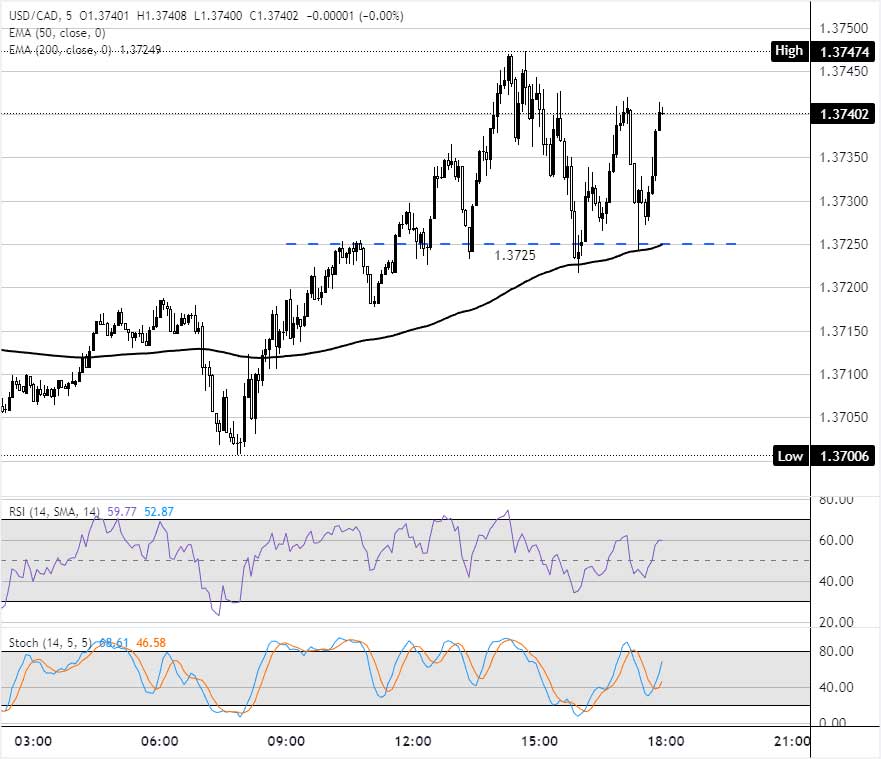
On the 5-minute chart, USD/CAD is trading near 1.3740, around 20 pips above the session open and modestly higher on the day. Price action is holding above the rising 200-period exponential moving average (EMA) at 1.3725, preserving a short-term bullish bias. Momentum indicators support this view, with the Relative Strength Index (RSI) at 59.77, in neutral-to-bullish territory, and the Stochastic oscillator climbing near 68.6, leaving room for further upside before overbought conditions emerge.
As long as price remains above the 200-period EMA, pullbacks are likely to find support. A sustained move below this level would weaken the intraday bullish structure and could trigger a deeper correction. With momentum indicators not yet stretched, buyers may attempt to extend gains, although upside momentum could fade if indicators begin to stall.
On the daily chart, USD/CAD is trading around 1.3741, still capped below the declining 50-day EMA at 1.3849 and the 200-day EMA at 1.3891. This configuration maintains a broader bearish bias, with the shorter-term average below the longer-term one reinforcing downside pressure. The daily RSI, at 40.9, has rebounded from oversold conditions but remains below the neutral 50 level.
The Stochastic oscillator has turned higher near 42.7, suggesting scope for a corrective rebound. However, any recovery is likely to face resistance near the 50-day EMA. Failure to reclaim this level would keep the risk tilted toward renewed weakness and potentially fresh lows, leaving sellers in control unless a decisive bullish break materializes.
Ready to start trading Forex? Join iXBroker today and kick-start your trading journey now!