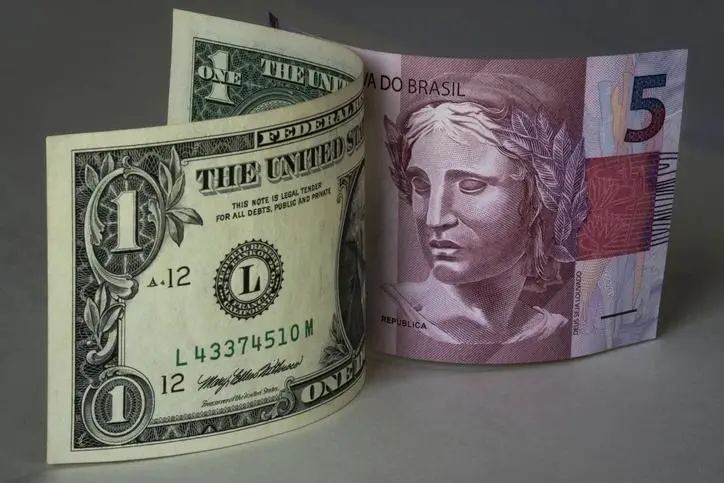
A Reuters poll indicates that the Brazilian real is likely to remain relatively stable in the near term, with concerns over external accounts and fiscal deficits restraining further appreciation.
According to a Reuters poll, the Brazilian currency (real) is expected to remain relatively stable over the coming months. This stability stems from concerns about the country’s external accounts and economic challenges that hinder significant appreciation of the currency.
Brazilian Real on a Path to Relative Stability
The Brazilian currency market is expected to remain relatively steady in the short term, supported by various factors. According to the latest Reuters poll, despite economic challenges and worries about external account balances, the real is not expected to experience major fluctuations in the upcoming months.
The real has performed better than anticipated since the beginning of 2025, supported by higher domestic interest rates and a weaker US dollar globally. These factors have helped keep the Brazilian currency relatively strong. However, concerns about Latin America’s largest economy’s ability to finance its current account deficit have made investors more cautious.
Real Exchange Rate Forecast Over the Next 12 Months
Based on the average forecast of 27 foreign exchange analysts surveyed between May 30 and June 3, the real’s exchange rate against the US dollar is expected to remain nearly unchanged by the end of this year, moving from the current 5.64 to 5.75 per dollar within 12 months — reflecting a modest depreciation of just 1.9%.
This contrasts with the January 2025 poll prediction of 5.97 for the end of June. The current forecast of 5.70 shows a 4.7% stronger outlook compared to earlier in the year, marking a recovery from the real’s weak position at the end of 2024.
Factors Influencing Real’s Stability
Analysts from Itau Unibanco have highlighted factors such as Brazil’s favorable interest rate differentials and hopes for progress in trade negotiations between the United States and China as key supports for the real. However, they also caution that a potential trade agreement between the US and other countries could reinforce what they term “American exceptionalism,” posing constraints on the real’s upside potential.
Domestic fiscal uncertainties and unfavorable trends in external accounts further limit more optimistic scenarios for the currency. Brazilian exporters face significant challenges, including a decline in poultry shipments due to avian influenza outbreaks and reduced soybean imports by China — both vital sectors for the country’s export-driven economy.
Outlook on Regional Currencies
In the survey’s additional question about risks to the real’s outlook over the next year, 6 out of 16 respondents anticipated a stronger currency, 5 expected depreciation, and 5 expressed neutral views.
Regarding other regional currencies, such as the Mexican peso, among 12 respondents, 5 expected strengthening, 4 foresaw weakening, and 3 remained neutral. The peso is forecast to depreciate approximately 6% over the next 12 months, moving from 19.23 to 20.46 per US dollar.
Meanwhile, Argentina’s peso is expected to trade around 1,440 per dollar within a year, slightly below the official adjustable trading band’s upper limit set in April 2025 at 1,400 plus a 1% monthly increase.
Performance of Regional Currencies This Year
Since the start of 2025, the Brazilian real has gained 9.6%, the Mexican peso has risen by 8.3%, while Argentina’s peso has depreciated by about 13%. However, the latter’s decline was less severe than initially feared following the relaxation of capital controls.