The Australian Dollar (AUD) extended its gains against the US Dollar (USD) on Monday, supported by stable monetary signals from China and cautious optimism surrounding the Reserve Bank of Australia’s (RBA) policy outlook. The People’s Bank of China (PBOC) kept its Loan Prime Rates (LPRs) unchanged, with the one-year rate holding at 3.00% and the five-year rate at 3.50%, helping to stabilize sentiment toward China-linked currencies such as the AUD.
Market participants are now turning their attention to the RBA’s Meeting Minutes, scheduled for release on Tuesday, for further insight into policymakers’ views on inflation and the future path of interest rates. According to pricing in ASX 30-Day Interbank Cash Rate Futures, the February 2026 contract was trading at 96.34 as of December 18, implying a 27% probability of a rate hike to 3.85% at the next RBA Board meeting.
US Dollar weakens as Fed signals patience
The US Dollar Index (DXY), which tracks the Greenback against a basket of six major currencies, slipped below recent highs and traded near the 98.60 level, snapping a three-day winning streak. Traders remain cautious ahead of Tuesday’s release of the US annualized Gross Domestic Product (GDP) data for the third quarter.
Cleveland Fed President Beth Hammack said over the weekend that monetary policy is well-positioned for a pause, emphasizing the need to assess the economic impact of the cumulative 75 basis points (bps) of rate cuts during the first quarter, according to Bloomberg.
Meanwhile, the Federal Reserve’s Summary of Economic Projections, commonly referred to as the “dot plot,” showed a median expectation of just one additional rate cut in 2026. The CME FedWatch tool indicates a 79.0% probability that the Fed will keep rates unchanged at its January meeting, up from 75.6% a week earlier. In contrast, the likelihood of a 25-bps rate cut has declined to 21.0%.
US inflation data also weighed on the Dollar. The Bureau of Labor Statistics reported that headline Consumer Price Index (CPI) inflation eased to 2.7% year-on-year in November, undershooting market expectations of 3.1%. Core CPI inflation, which excludes food and energy prices, rose by 2.6%, below forecasts of 3.0% and marking the slowest pace since 2021.
Adding to market speculation, US President Donald Trump said last week that the next Federal Reserve Chair would be someone who strongly favors significantly lower interest rates, noting that an announcement regarding a successor to current Chair Jerome Powell would be made soon. Fed Governor Christopher Waller, a potential candidate, reiterated his dovish stance during a CNBC forum, stating that policymakers can afford to ease policy gradually as inflation continues to cool.
AUD/USD holds above 0.6600 as bullish bias persists
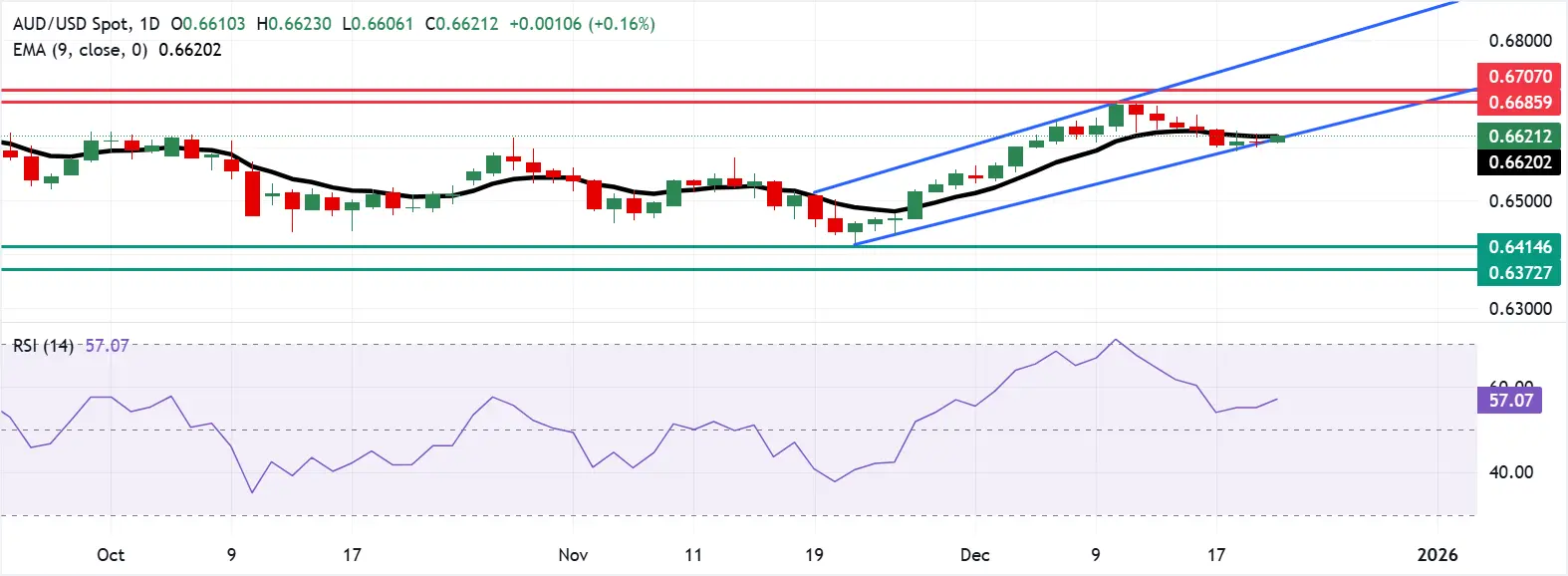
The AUD/USD pair traded just below the 0.6620 level on Monday, maintaining a constructive technical outlook. On the daily chart, the pair continues to hover near the lower boundary of an ascending channel, suggesting the broader bullish trend remains intact as long as support holds.
The 14-day Relative Strength Index (RSI) stands at 57.05, reflecting neutral-to-bullish momentum and remaining comfortably above its midline, which keeps buyers in control. The nine-day Exponential Moving Average (EMA) is trending higher and sits just above spot prices, acting as near-term resistance. Although the EMA has flattened recently, signaling short-term consolidation, the overall bias remains mildly positive.
A sustained break above the nine-day EMA near 0.6620 would strengthen upside momentum, opening the door toward the three-month high at 0.6685, followed by 0.6707, the highest level since October 2024. On the downside, a decisive break below the ascending channel could accelerate selling pressure, exposing the six-month low near 0.6414, last seen on August 21.
Ready to start trading Forex? Join iXBroker today and kick-start your trading journey now!