The Australian Dollar (AUD) edges lower against the US Dollar on Thursday after fresh data showed Australia’s trade surplus narrowed sharply in November. According to figures released by the Australian Bureau of Statistics, the trade balance fell to AUD 2.94 billion month-on-month, down from a revised AUD 4.35 billion in the previous month, weighing modestly on the currency.
The softer trade outcome reflects a notable slowdown in export momentum. Exports declined by 2.9% month-on-month in November, reversing the prior month’s revised 2.8% increase. At the same time, imports rose slightly by 0.2%, following a stronger 2.4% expansion in October, further compressing the surplus and limiting near-term support for the Aussie.
Inflation data clouds RBA policy outlook
Uncertainty surrounding the Reserve Bank of Australia’s policy path continues to linger after mixed inflation signals. November Consumer Price Index data showed headline inflation easing to 3.4% year-on-year from 3.8% previously, missing market expectations but remaining above the RBA’s 2–3% target range. The reading marked the slowest pace of inflation since August, with housing costs rising at their weakest rate in three months.
Despite the moderation, RBA Deputy Governor Andrew Hauser said the inflation outcome was broadly in line with expectations and reiterated that interest rate cuts are unlikely in the near term. With the monthly CPI offering limited clarity, market focus is now shifting to the quarterly inflation report due later this month, which is expected to provide more definitive guidance on the RBA’s next policy move.
US dollar steady ahead of key labor data
On the US side, the US Dollar Index is holding near 98.70 as investors remain cautious ahead of critical labor market data. The Greenback has struggled to build momentum as recent indicators point to a fragile economic backdrop, reinforcing expectations of a cautious Federal Reserve.
Traders are monitoring Weekly Initial Jobless Claims later on Thursday, while attention is firmly fixed on Friday’s US Nonfarm Payrolls report. The December jobs data is expected to show an increase of around 55,000 positions, down from 64,000 in November, potentially shaping near-term Fed policy expectations.
Mixed US data reinforces cautious Fed outlook
Recent US data releases have delivered a mixed picture. The ISM Services PMI rose to 54.4 in December from 52.6 previously, beating expectations and signaling resilience in the services sector. However, labor market indicators were less encouraging.
ADP data showed private-sector employment increased by 41,000 in December, below market forecasts, while the JOLTS report revealed job openings fell to 7.146 million in November, underscoring a gradual cooling in labor demand. Dovish commentary from Fed officials, including calls for aggressive rate cuts to support growth and warnings of a potential rise in unemployment, has further capped the Dollar’s upside.
China data and domestic signals remain in focus
Developments in China continue to influence AUD sentiment, given Australia’s strong trade ties with its largest export partner. China’s services PMI edged lower in December, while manufacturing activity showed only a marginal improvement, keeping concerns over regional growth dynamics alive.
Domestically, Australian CPI was unchanged on a monthly basis in November, while the RBA’s trimmed mean measure rose 0.3% month-on-month and 3.2% year-on-year. Meanwhile, building approvals surged 15.2% in November to their highest level in nearly four years, highlighting pockets of resilience in the housing sector. Still, commentary in the Australian Financial Review has fueled speculation that the RBA may not yet be finished with tightening, as inflation risks remain elevated.
Technical outlook: AUD/USD pulls back from recent highs
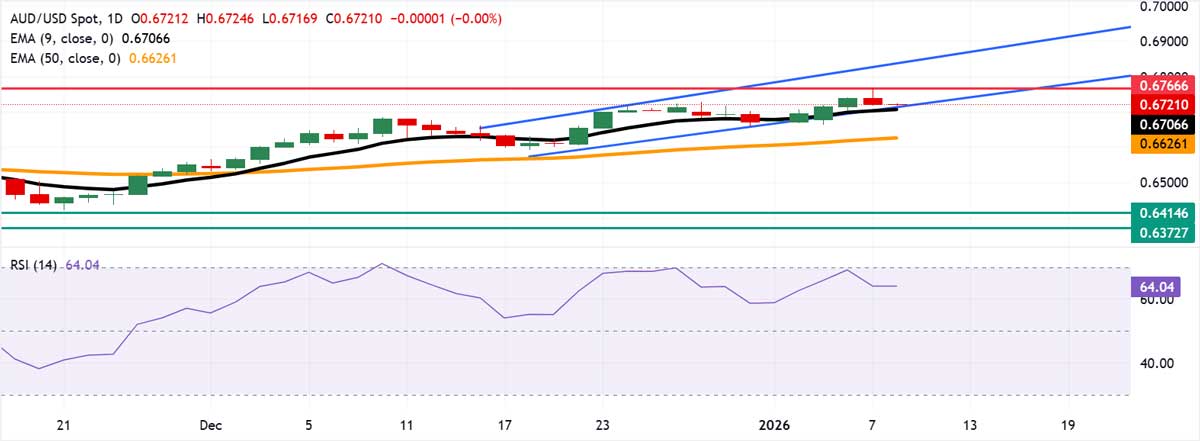
AUD/USD is trading near the 0.6720 area after retreating from 15-month highs. From a technical perspective, the pair remains within an ascending channel on the daily chart, suggesting the broader bullish structure is intact. The 14-day Relative Strength Index stands around 64, indicating positive momentum, though short-term consolidation is underway.
On the upside, a break above recent highs could open the door toward 0.6766, followed by the upper boundary of the ascending channel near 0.6840. Initial support is seen around 0.6720, aligned with the lower channel boundary, with additional support at the nine-day Exponential Moving Average near 0.6706. A sustained move below this zone could expose deeper support near the 50-day EMA around 0.6626.
Ready to start trading Forex? Join iXBroker today and kick-start your trading journey now!