The Australian Dollar (AUD) extended its rally against the US Dollar (USD) on Wednesday, marking a fourth consecutive session of gains and pushing AUD/USD to fresh 15-month highs. The pair advanced despite signs of easing inflation in November, as markets remain focused on the Reserve Bank of Australia’s (RBA) still-hawkish policy outlook and the upcoming fourth-quarter CPI report.
Expectations are building that a stronger-than-forecast Q4 core inflation reading could prompt the RBA to resume tightening as early as its February meeting. Analysts warn that a quarterly rise of 0.9% or more in core inflation would likely strengthen the case for another rate hike.
RBA outlook supports AUD despite softer inflation data
The Australian Financial Review reported that the RBA may not be finished with its tightening cycle. According to its latest survey, inflation is expected to remain stubbornly elevated over the next year, reinforcing market expectations for at least two additional rate hikes.
Data from the Australian Bureau of Statistics showed that headline CPI rose 3.4% year-on-year in November, easing from 3.8% in October and falling short of the market forecast of 3.7%. While this marked the lowest inflation reading since August, price pressures remain above the RBA’s 2–3% target band. Housing costs also increased at the slowest pace in three months, providing some relief on the inflation front.
On a monthly basis, CPI was unchanged at 0.0%, matching October’s reading. Meanwhile, the RBA’s Trimmed Mean CPI increased by 0.3% month-on-month and 3.2% year-on-year, highlighting that underlying inflation pressures persist.
Strong housing data adds to domestic resilience
Australia’s housing sector showed renewed strength, with seasonally adjusted Building Permits surging 15.2% month-on-month in November to 18,406 units, near a four-year high. This followed a downwardly revised 6.1% decline in the previous month. On an annual basis, approvals jumped 20.2%, reversing October’s revised 1.1% fall and underscoring resilience in domestic demand.
US Dollar softens ahead of key data and Fed signals
The US Dollar Index (DXY) edged lower after modest gains in the previous session, hovering near the 98.50 level at the time of writing. Investors remain cautious ahead of key US data releases, including the ISM Services PMI and JOLTs job openings, which could influence expectations for Federal Reserve (Fed) policy.
The upcoming US Nonfarm Payrolls report, due Friday, is expected to show job gains of 55,000 in December, down from 64,000 in November. Recent commentary from Fed officials has leaned dovish, with Governor Stephen Miran stating that aggressive rate cuts may be needed this year to support economic momentum. Minneapolis Fed President Neel Kashkari also warned of the risk that the unemployment rate could rise sharply.
Richmond Fed President Tom Barkin noted that future rate adjustments would need to be finely calibrated to incoming data, citing risks to both employment and inflation objectives. According to the CME Group’s FedWatch tool, markets are pricing in an 82.8% probability that the Fed will keep rates unchanged at its January meeting.
Geopolitical developments have also added to uncertainty, with escalating tensions involving Venezuela and ongoing speculation that US President Donald Trump may nominate a new Fed chair when Jerome Powell’s term ends in May, a move that could shift policy expectations toward lower interest rates.
China data and RBA minutes remain in focus
China’s RatingDog Services PMI eased slightly to 52.0 in December from 52.1 in November, while Manufacturing PMI edged up to 50.1 from 49.9. Any shifts in China’s economic outlook remain important for the Australian Dollar, given the close trade relationship between the two economies.
Minutes from the RBA’s December meeting reiterated that policymakers stand ready to tighten policy further if inflation does not ease as expected, placing heightened emphasis on the Q4 CPI report due on January 28. A stronger-than-expected outcome could pave the way for a rate hike at the February 3 meeting.
AUD/USD hits fresh highs but shows overbought signals
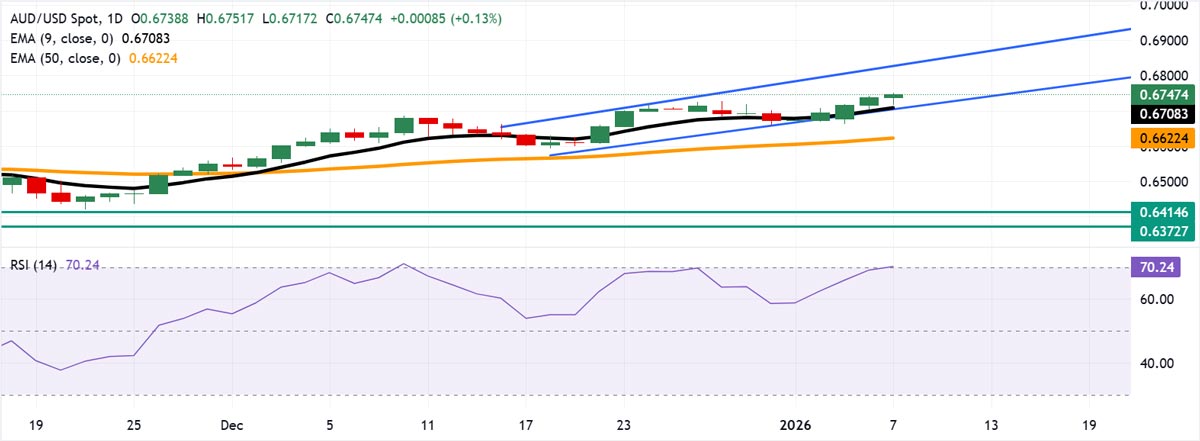
AUD/USD is trading around the 0.6750 area, having reached its highest level since October 2024. Daily chart analysis shows the pair moving within an ascending channel, confirming a sustained bullish trend. However, the 14-day Relative Strength Index is hovering near 70, suggesting overbought conditions.
The pair is now targeting the upper boundary of the ascending channel near 0.6830. On the downside, initial support is seen at the nine-day Exponential Moving Average around 0.6708, followed by the lower boundary of the channel near 0.6700. A decisive break below this zone could expose the pair to the 50-day EMA near 0.6625.
Ready to start trading Forex? Join iXBroker today and kick-start your trading journey now!