EUR/USD remains under pressure during Friday’s European session, trading around the 1.1720 area ahead of the US opening and extending its pullback from late-December highs above 1.1800. The pair has been weighed down by weaker-than-expected manufacturing activity data across the Eurozone, which has reinforced bearish sentiment toward the Euro in an otherwise quiet New Year trading environment.
Despite the latest decline, the broader picture still shows the pair trading not far from its three-month peak at 1.1808, reached just before Christmas. The US Dollar (USD) lost roughly 14% against the Euro in 2025, pressured by market unease over US President Donald Trump’s unpredictable trade policies, signs of a slowing US economy, and growing monetary policy divergence between the European Central Bank (ECB) and the US Federal Reserve (Fed).
Eurozone data highlights manufacturing slowdown
Final HCOB Manufacturing Purchasing Managers’ Index (PMI) readings for Germany and the Eurozone confirmed a weakening contribution from the manufacturing sector to regional GDP growth. The Eurozone HCOB Manufacturing PMI was revised down to 48.8 in December from a preliminary estimate of 49.2, marking a deeper contraction compared with November’s 49.6 and October’s 50.0 readings.
Germany’s HCOB Manufacturing PMI was also revised lower, with December’s figure at 47.0 versus the preliminary 47.7 and November’s 48.2, underscoring persistent weakness in the bloc’s largest economy.
Elsewhere, Italy’s Manufacturing PMI fell sharply to 47.9 in December from 50.6 in November, while Spain’s index declined to 49.6 from 51.5. France was the only relative bright spot, with its Manufacturing PMI edging up slightly to 50.7 from 50.6.
Attention later in the day turns to the final US S&P Global Manufacturing PMI. The preliminary release pointed to a modest slowdown, with December’s reading at 51.8 compared with 52.2 in November, still consistent with moderate expansion in business activity.
Daily digest: markets await US data and Fed signals
The Euro is broadly weaker against its major peers on the back of the disappointing European manufacturing figures. While the immediate focus is on US PMI data, investors are also positioning ahead of next week’s US Nonfarm Payrolls report, a key input for Fed policy expectations. In addition, markets remain alert to developments around the eventual replacement of Fed Chair Jerome Powell, which is expected to be announced in the coming weeks and could influence longer-term USD dynamics.
Technical analysis: EUR/USD tests key support near 1.1700
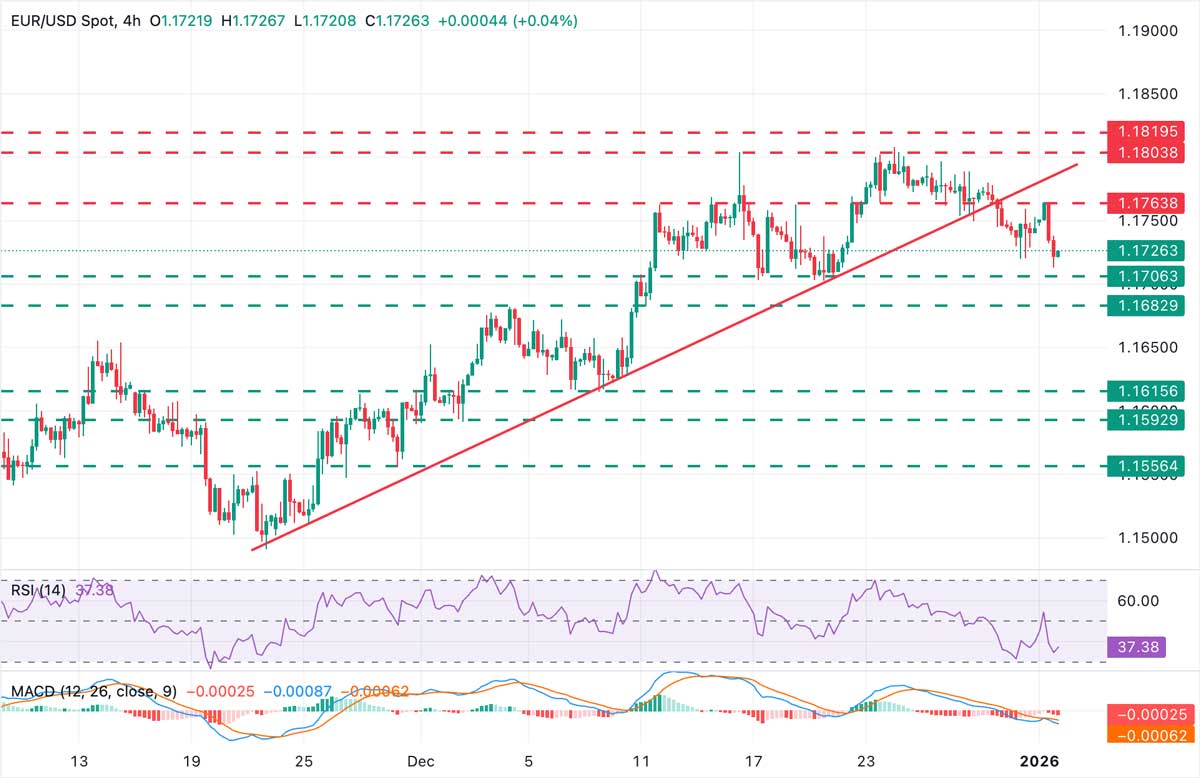
From a technical perspective, EUR/USD maintains a bearish bias after breaking below the trendline drawn from mid-November lows. On the 4-hour chart, the Relative Strength Index (RSI) has been rejected at the 50 level, while the Moving Average Convergence Divergence (MACD) has turned lower after failing to cross its signal line, highlighting increasing downside momentum.
A clear break below the December 17 and 19 lows near 1.1700 would confirm a broader bearish shift, opening the door toward the 1.1680 area, defined by the December 4 high and December 11 low, and then the December 8 and 9 lows around 1.1615.
On the upside, recovery attempts have so far been capped near 1.1764. Further resistance is seen at the descending trendline around 1.1785, followed by the December 16 and 24 highs above the 1.1800 psychological level.
Ready to start trading Forex? Join iXBroker today and kick-start your trading journey now!