The Bitcoin-to-silver price ratio is gaining attention as a macro-level indicator that reflects changes in investor risk appetite, highlighting how capital rotates between digital assets and traditional hard assets during periods of uncertainty.
As global markets continue to digest macroeconomic pressures, the relationship between Bitcoin and silver prices has become increasingly relevant. The Bitcoin–silver price ratio, which measures how many ounces of silver are needed to purchase one Bitcoin, offers insight into investor positioning across asset classes rather than serving as a direct trading signal.
By tracking this ratio, market participants can better assess broader risk-on and risk-off dynamics as liquidity conditions and sentiment evolve.
Understanding the Bitcoin-silver price ratio
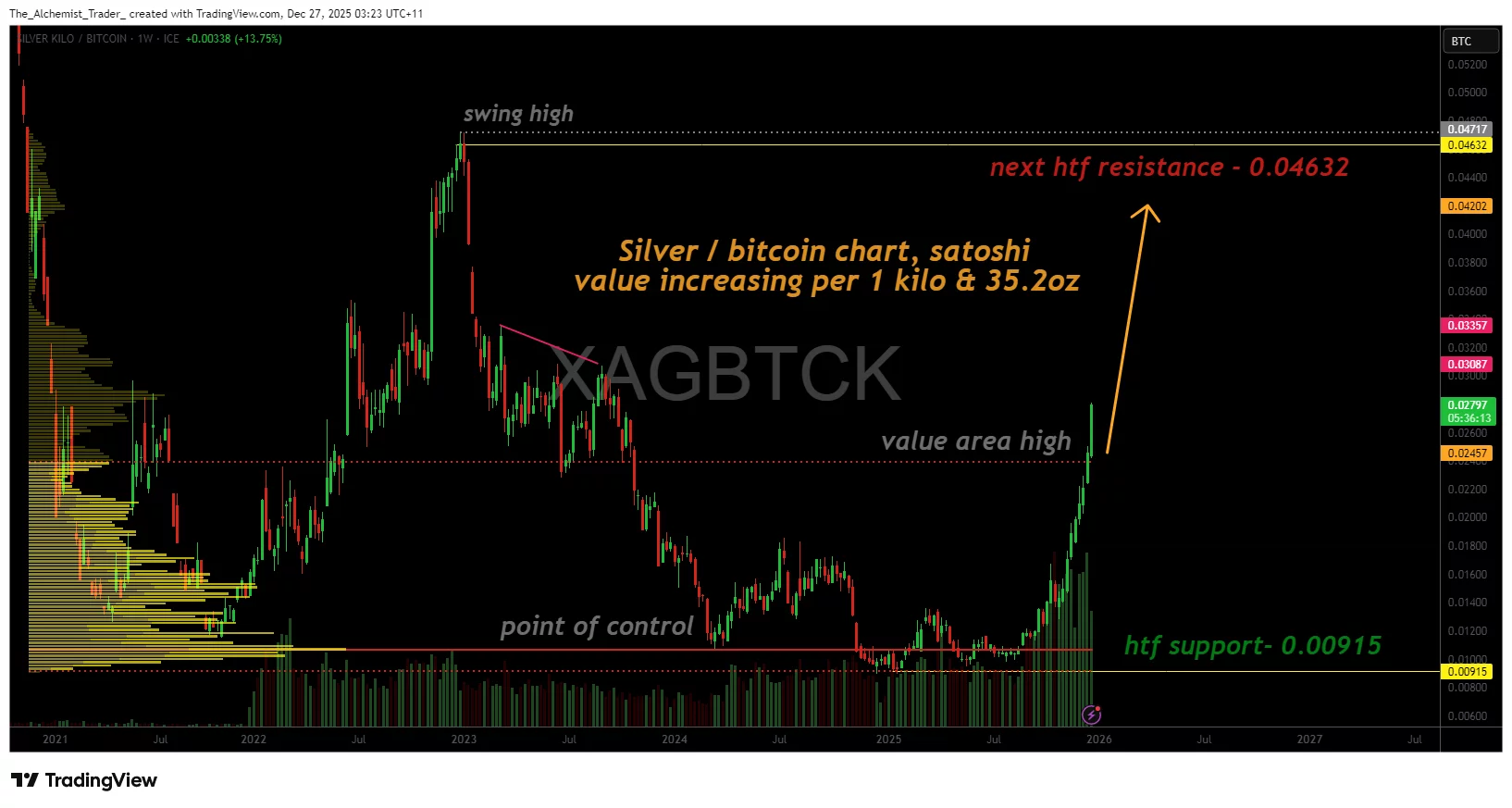
When silver prices rise, Bitcoin priced in silver terms also increases. This relationship exists because Bitcoin is often compared to hard assets such as silver to gauge relative value. As silver becomes more expensive, Bitcoin must demonstrate stronger performance simply to maintain its position against a rising benchmark.
Even if Bitcoin’s USD price remains unchanged, it can still appear more expensive in silver terms when silver strengthens. This shift suggests that investors are placing increased value on physical assets, signaling a change in underlying market preferences.
As silver gains momentum, the valuation threshold for Bitcoin rises, implying that Bitcoin must attract additional demand to preserve its relative appeal.
Risk-on environments tend to favor Bitcoin
Periods marked by a declining Bitcoin–silver price ratio typically align with improving liquidity conditions. In these phases, investors show greater willingness to allocate capital toward higher-volatility assets, favoring Bitcoin over defensive holdings like silver.
Historically, falling ratios have coincided with Bitcoin bull markets, driven by expanding liquidity and heightened speculative activity. During such periods, silver often underperforms as capital rotates away from traditional hedges and toward growth-oriented assets.
This behavior reinforces Bitcoin’s sensitivity to liquidity trends and monetary expectations.
Rising ratio points to defensive capital rotation
When the Bitcoin–silver price ratio rises, it indicates that silver is outperforming Bitcoin, a pattern commonly associated with risk-off environments. In these conditions, investors tend to prioritize capital preservation over return-seeking strategies.
Such phases often emerge amid macroeconomic stress, tighter financial conditions, or increased uncertainty around inflation and interest rate trajectories. Silver’s physical characteristics and industrial demand make it more attractive defensively, while Bitcoin’s volatility becomes a relative disadvantage.
A rising ratio does not automatically signal a bearish outlook for Bitcoin. Instead, it often reflects temporary caution, with capital rotating defensively until risk appetite begins to recover.
Mean reversion at extreme levels
Historically, extreme readings in the Bitcoin–silver price ratio have preceded periods of mean reversion. When Bitcoin becomes deeply undervalued relative to silver, it can indicate excessive defensive positioning, potentially setting the stage for renewed inflows into crypto markets.
Conversely, when Bitcoin becomes significantly overextended versus silver, corrective or consolidation phases often follow as markets rebalance. These extremes are more effective for identifying broader cycle dynamics rather than short-term trading opportunities.
Macro liquidity remains the dominant driver
Macro liquidity conditions play a central role in shaping the Bitcoin–silver price ratio. Silver is primarily influenced by real yields, industrial demand, and inflation expectations, while Bitcoin reacts more directly to monetary policy shifts, liquidity expansion, and institutional participation.
As a result, divergences in the ratio can act as early signals of changing liquidity regimes, sometimes appearing before adjustments in broader risk markets. For this reason, macro-focused traders often monitor the ratio alongside real interest rates, the US dollar index, and Bitcoin dominance metrics.
What the ratio suggests for investors now
The Bitcoin–silver price ratio underscores the ongoing balance between digital scarcity and traditional hard assets. While it should not be analyzed in isolation, it offers valuable insight into how capital is repositioning beneath the surface of the market.
The recent strength in silver prices suggests the possibility of a more prolonged consolidation phase for Bitcoin, which continues to be viewed primarily as a risk-on asset. In today’s interconnected macro landscape, understanding this relationship can help investors better interpret shifts in sentiment and liquidity.
Ready to start trading Forex? Join iXBroker today and kick-start your trading journey now!