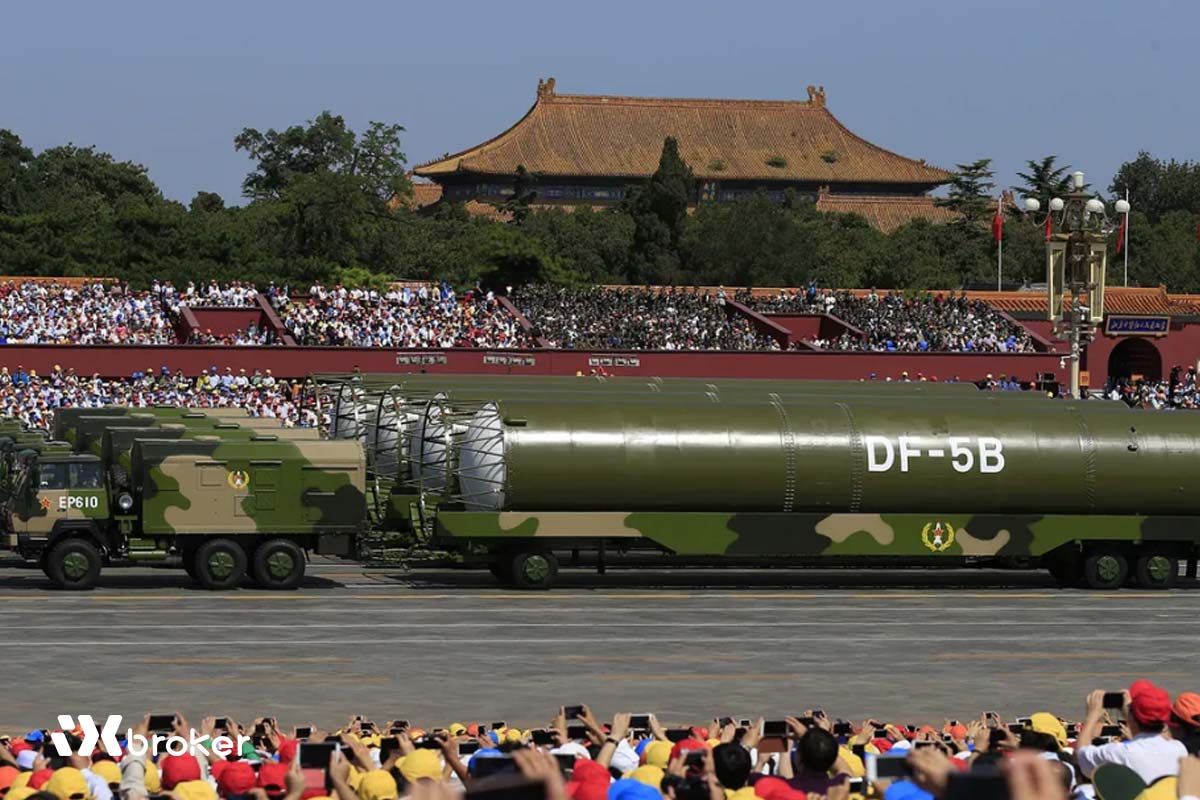
BEIJING — Chinese President Xi Jinping stated on Wednesday that the world is facing a critical choice between “peace or war” and “dialogues or confrontation,” as the country hosted its largest military parade in honor of the 80th anniversary of the end of World War II.
Xi’s remarks were made during a ceremony that also saw U.S. President Donald Trump post a message on Truth Social urging the Chinese leader to recognize the U.S. role in helping secure China’s freedom, while alleging that Beijing was conspiring against Washington.
“Please give my warmest regards to Vladimir Putin, and Kim Jong Un, as you conspire against the United States of America,” Trump wrote.
Russian President Vladimir Putin and North Korean leader Kim Jong Un were among over 20 international leaders attending the military parade at Tiananmen Square in Beijing. The event marked a key moment in China’s commemorative efforts and included a reception and gala later in the evening.
Despite the high-profile presence of Putin and Kim, experts suggest that the gathering is unlikely to derail ongoing U.S.-China trade talks. Neil Thomas, a fellow at the Asia Society focusing on Chinese politics, noted that while Beijing’s growing influence in regional diplomacy is clear, both sides of the trade dispute appear committed to negotiating a deal in the coming months.
Tensions between the U.S. and China escalated in April with the imposition of aggressive tariffs, but there is hope that upcoming in-person meetings between Trump and Xi may ease these tensions, with tariffs expected to be removed by mid-November.
In his speech, Xi emphasized China’s commitment to enhancing its military strength. Though he did not directly mention Taiwan, the self-ruled island that China claims as its own, Xi highlighted the role of the Chinese military in defending the nation’s sovereignty and territorial integrity.
The parade, which showcased China’s latest military capabilities, featured missiles, military trucks, tanks, autonomous vehicles, and other equipment, with soldiers marching in formation and fighter jets flying over the capital. The event was carefully choreographed to highlight China’s domestically produced, advanced weapons and equipment.
Parade announcers also emphasized China’s efforts to ensure internet and information security, underscoring the country’s growing technological influence.
Shifting patterns of Chinese influence
The parade’s foreign attendees underscored the shifting patterns of Chinese global influence, with Western leaders notably absent. Jeremy Chan, senior analyst at Eurasia Group, observed that eight leaders from Southeast Asia were present, signaling China’s increasing regional influence. South Korea’s president declined the invitation, while Kim Jong Un’s unexpected attendance highlights strengthening ties between Beijing and Pyongyang.
Kim’s attendance is seen as part of China’s strategy to maintain close relations with North Korea amid growing cooperation between North Korea and Russia, as well as renewed diplomatic efforts from Seoul and Washington to engage with Pyongyang.
Reports indicate that North Korea has sent troops to Russia in support of its military actions in Ukraine, while Beijing has refrained from labeling Moscow’s actions as an invasion, instead positioning itself as a peace broker. Despite U.S. accusations of Chinese support for Russia’s military efforts, China has denied any involvement.
North Korea’s Kim Ju Ae makes diplomatic appearance
Kim Jong Un’s daughter, Kim Ju Ae, also attended the event, which experts in North Korean affairs believe is a significant diplomatic gesture. Cheong Seong-Chang, vice president of the Sejong Institute, noted that her placement directly behind Kim Jong Un at the event reflects her rising importance in North Korean leadership.
The parade occurred just days after leaders including Putin gathered in Tianjin for the largest-ever summit of the Shanghai Cooperation Organization. India’s Prime Minister Narendra Modi was notably absent from the parade, though a viral photo of him laughing with Putin and Xi on the summit sidelines sparked attention.
In May, Xi and Putin attended a similar military parade in Moscow, and they met again in Beijing on Tuesday, where the two countries signed a legally binding agreement to proceed with the long-delayed Power of Siberia 2 gas pipeline project.
China’s growing regional influence
China has sought to exert more influence in regional diplomacy, particularly in light of ongoing geopolitical uncertainty. The absence of Western leaders at the parade, coupled with the attendance of leaders from Southeast Asia and North Korea, signals a shift in global alignments.
China’s increased involvement in regional and global diplomacy is marked by its expanding role in trade and economic negotiations. Experts argue that the growing ties between Beijing and Moscow, as well as Pyongyang’s participation in these diplomatic efforts, demonstrate China’s strengthening position in global politics.
Past military parades and global reactions
This marks the first military parade since 2019, when China celebrated the 70th anniversary of the Chinese Communist Party’s rule. At that time, Xi boldly declared that “no force can stop the Chinese people and the Chinese nation from forging ahead.”
Notably, Putin attended the 2015 military parade in Beijing to commemorate the 70th anniversary of the end of World War II. Other notable figures at the 2015 parade included then-South Korean President Park Geun-hye and government representatives from the U.S. and France.
This year’s event, labeled as the “80th anniversary of China’s victory over Japanese aggression and the world’s victory against fascism,” concluded with a symbolic release of doves and colored balloons, reinforcing China’s message of peace amidst rising geopolitical tensions.